Free web tool
Norwood scale: which stage are you?
The Norwood scale is a 7-stage chart doctors use to describe male pattern hair loss, from no recession (stage 1) to hair left only at the sides and back (stage 7).[1][2] Pick the drawing below that looks most like your hair to see which stage it matches.
What are the 7 Norwood stages?
Dr O'Tar Norwood published the scale in 1975 after studying hair loss in 1,000 men.[1]He revised an earlier classification by James Hamilton from 1951, which is why you will also see it called the Hamilton-Norwood scale.[2] It has 7 main stages, plus a stage 3 "vertex" for men whose crown thins before the front and crown join up.
| Stage | What it looks like | In plain words |
|---|---|---|
| Stage 1 | A full hairline with little or no recession at the temples and no thinning at the crown. | A hairline like this shows no visible sign of pattern hair loss. |
| Stage 2 | Small triangular areas of recession at the temples, usually the same on both sides. | Often called a mature hairline. Norwood did not count this stage as baldness. |
| Stage 3 | The temples have moved back enough to give an M, U or V shape from above. | The first stage Norwood counted as baldness. |
| Stage 3 vertex | The hairline is like stage 2 or 3, with a thinning patch at the crown (the vertex). | Easy to miss, because you cannot see your own crown without a second mirror or a camera. |
| Stage 4 | Deeper recession at the front and a bigger thin area at the crown, with a band of hair still between them. | Clear hair loss in two areas that have not yet joined. |
| Stage 5 | The band of hair between the front and the crown is thinner and narrower. | The two areas are close to meeting. |
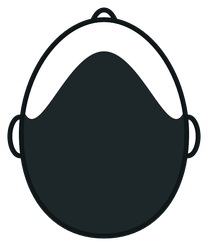
| Stage 6 | The band across the top has gone. The front and crown are one area. | Hair remains at the sides and back, and sits high on the sides. |
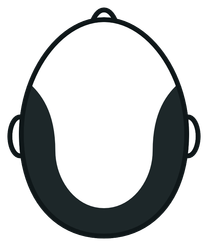
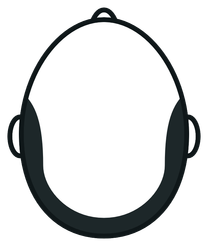
| Stage 7 | Only a band of hair around the sides and back remains. | The most advanced stage on the scale. |





Is a Norwood stage a diagnosis?
No. A Norwood stage describes a pattern. It does not tell you why you are losing hair or what will happen next. Two men at stage 3 can be on very different paths: one has looked the same for 10 years, the other was at stage 2 last spring.
Male pattern hair loss tends to move very slowly, over several years to decades.[4]That is why a single look in the mirror tells you little. What matters is whether your stage is changing, and how fast.
Is stage 2 a mature hairline?
Often, yes. Hairlines change shape with age, and a paper on normal hairline maturing describes the male hairline changing shape between about 18 and 29.[3] On the chart a matured hairline usually sits at stage 2, and Norwood himself only counted stage 3 and beyond as baldness.[2]
The drawings cannot tell a settled stage 2 from one that is still moving. Photos taken months apart can. Our guide on telling a mature hairline from a receding one goes through it.
How do I check my crown?
You cannot see your own crown in one mirror. Stand with your back to a wall mirror and hold a second mirror in front of you, or hold your phone above the back of your head and take a photo. Use the same room and the same light each time, because a bright light straight above makes any crown look thinner.
Read next
- How long does minoxidil take to work?Free web tool
- Mature hairline or receding hairline? How to tellGuide
- How to take hair progress photos that show real changeGuide
- Microneedling with minoxidil: how I do it, and what the studies foundGuide
Sources
We opened each of these on 21 November 2026. If anything has changed since, the source is right and we're out of date.
- Norwood OT. Male pattern baldness: classification and incidence. Southern Medical Journal, 1975. PMID 1188424. pubmed.ncbi.nlm.nih.gov
- Gupta M, Mysore V. Classifications of patterned hair loss: a review. Journal of Cutaneous and Aesthetic Surgery, 2016. PMID 27081243. pmc.ncbi.nlm.nih.gov
- Rassman WR, Pak JP, Kim J. Phenotype of normal hairline maturation. Facial Plastic Surgery Clinics of North America, 2013. PMID 24017973. pubmed.ncbi.nlm.nih.gov
- British Association of Dermatologists. Hair loss male pattern (androgenetic alopecia): patient information leaflet. Updated June 2024. skinhealthinfo.org.uk
- NHS. Hair loss. Page last reviewed 24 January 2024. nhs.uk